Ghidra: reverse engineering profesional con el toolkit de la NSA
· 10 min de lectura
Ghidra liberado por la NSA 2019 democratizó el reverse engineering profesional. Aprende el workflow completo: análisis estático, decompilación, scripting, debugging y comparación con IDA Pro y Binary Ninja para análisis de malware, vulnerability research y auditoría de binarios.
Ghidra es el toolkit de reverse engineering publicado por la NSA (National Security Agency) en 2019 como open source, desclasificando una herramienta usada internamente durante años. Su release democratizó el reverse engineering profesional: antes de Ghidra, análisis serio de binaries requería licencia IDA Pro ($$$) o Binary Ninja. Ghidra ofrece decompiler competitivo, scripting en Java/Python, colaboración multi-user, y soporte para docenas de arquitecturas (x86, ARM, MIPS, PowerPC, RISC-V, Z80, incluso arquitecturas esotéricas) gratis. Para malware analysts, vulnerability researchers, embedded security specialists, y CTF players, Ghidra es herramienta essential en 2026.
Esta lección cubre workflow completo de Ghidra, comparación con IDA Pro y Binary Ninja, técnicas de análisis estático, el decompiler (feature killer de Ghidra), scripting Python/Java, debugging integration, y uso cases canonicales: malware analysis, vulnerability research, firmware analysis, patch diffing. Es la quinta lección de la Tanda 7.
Reverse engineering en own software o samples legally obtained (open source, academic research, personal purchases). Reversing commercial software without permission can violate DMCA en US.
Workflow básico Ghidra#
Setup típico:
# Download Ghidra
wget https://github.com/NationalSecurityAgency/ghidra/releases/download/Ghidra_11.0_build/ghidra_11.0_PUBLIC_20231222.zip
unzip ghidra_*.zip
cd ghidra_*
./ghidraRun
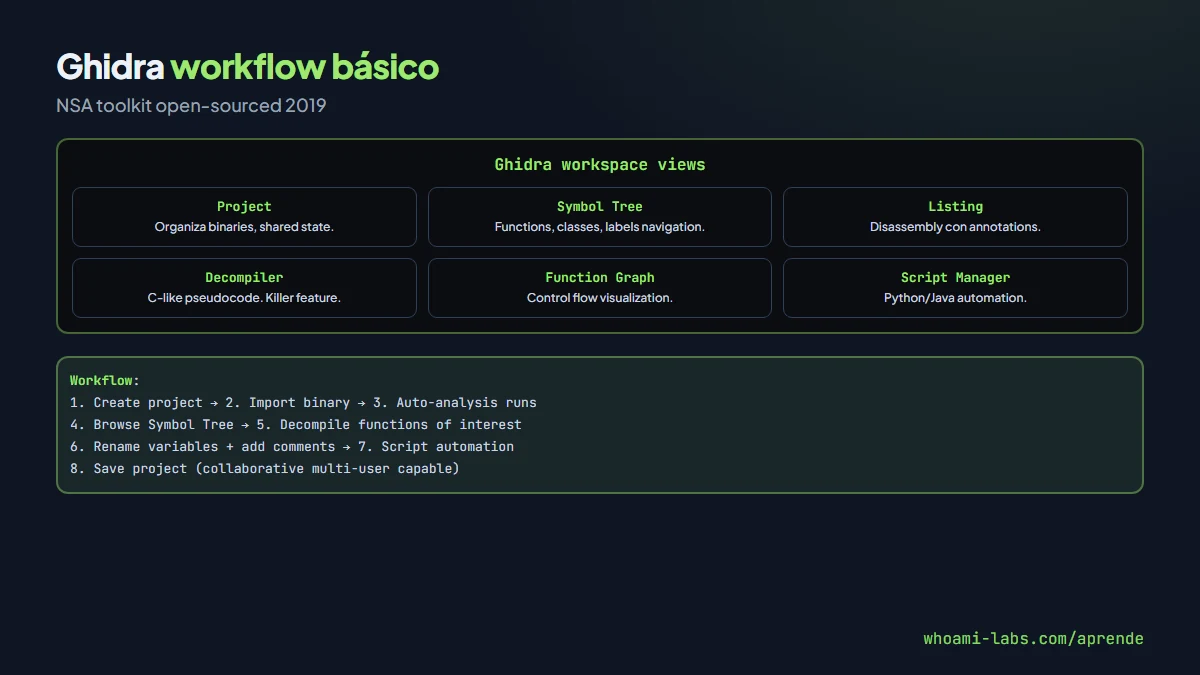
Workflow:
- Create project (organizes multiple binaries).
- Import binary (auto-detects format: PE, ELF, Mach-O, firmware).
- Auto-analysis runs (may take minutes for large binaries).
- Browse symbol tree, program tree, listing view.
- Use decompiler for high-level C-like view.
- Mark functions, add comments, rename variables.
- Save progress en project.
Key features#
Decompiler#
The killer feature. Converts assembly → C-like pseudocode:
// Original disassembly: 50 lines x86
// Ghidra decompiled:
int process_input(char *input) {
    char buffer[64];
    strcpy(buffer, input);  // obvious buffer overflow
    return strlen(buffer);
}
Readable, structured, often spot bugs quickly. Competitive with IDA Hex-Rays (expensive addon).
Symbol tree#
Navigate functions, classes, symbols. Especially useful for large binaries.
Program graph#
Visualize control flow. Function graph shows basic blocks + branches. Call graph shows caller/callee relationships.
Scripting#
Python 2/3 + Java. Automate analysis:
# List all functions con "crypto" en nombre
from ghidra.app.script import GhidraScript

func_mgr = currentProgram.getFunctionManager()
for func in func_mgr.getFunctions(True):
    if "crypto" in func.getName().lower():
        print(func.getName(), func.getEntryPoint())
Scripts en ghidra_scripts/ folder. Share con community.
Diffing#
Compare two binaries (patched vs unpatched version). Critical for 1-day exploit development:
- Load both versions.
- BinDiff / Diaphora integration.
- Find changed functions.
- Focus analysis on diffs.
Common workflow for patch analysis.
Debugger integration (new feature)#
Ghidra 10+ added debugger. Attach GDB, debug while viewing disassembly/decompilation. Reduces context switching.
Ghidra vs alternatives#
IDA Pro#
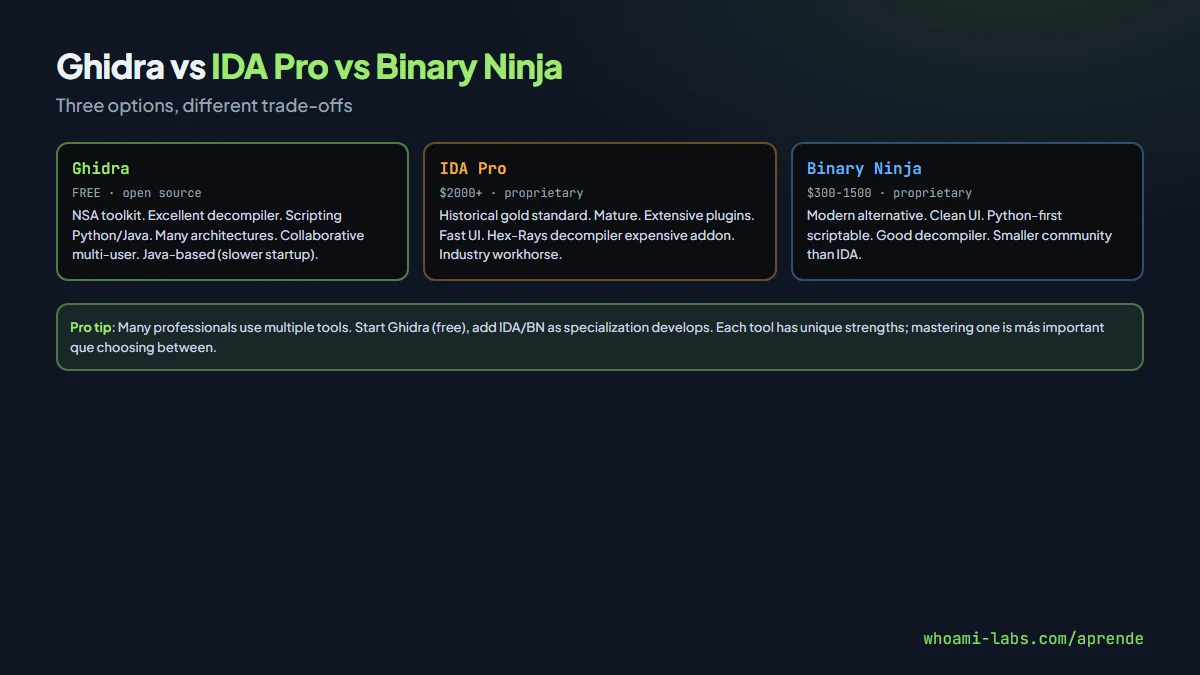
Historical gold standard. Still used heavily. Pros:
- Mature, battle-tested.
- Extensive plugin ecosystem.
- Fast UI.
- Best disassembler many agree.
Cons:
- Expensive ($2000+ per license).
- Decompiler (Hex-Rays) extra cost.
- Proprietary.
Binary Ninja#
Modern commercial alternative. Pros:
- Clean UI.
- Scriptable Python-first.
- Reasonable price ($300-1500).
- Good decompiler.
Cons:
- Smaller community than IDA.
- Less plugin ecosystem.
Ghidra#
Pros:
- Free + open source.
- Excellent decompiler.
- Many architectures supported.
- Collaborative (multi-user project).
- Headless mode for automation.
Cons:
- Java-based (slower startup).
- UI más clunky.
- Smaller plugin ecosystem than IDA.
En 2026, choice depends preference + budget. Many professionals use multiple (switch based on target).
Use cases principales#
Malware analysis#
- Load malware sample en Ghidra.
- Identify entry point, main loop.
- Trace API calls (detect persistence, C2 communication).
- Dump decoded strings (post-decryption).
- Export IOCs for threat intel.
Combined with dynamic analysis (lección Volatility), comprehensive malware understanding.
Vulnerability research#
- Target binary (closed-source commercial product).
- Identify attack surface (network handlers, file parsers).
- Analyze for common bug patterns (missing bounds checks, UAF patterns).
- Develop PoC exploits.
Hours-to-days per function focus.
Firmware analysis#
- Extract firmware (binwalk).
- Identify file format (SPI flash dump, UBI, etc.).
- Load into Ghidra con correct architecture.
- Analyze bootloader, OS, applications.
IoT / embedded security relies heavily on this workflow.
Patch diffing#
- Download vendor advisory + patched binary.
- Diff against vulnerable version.
- Identify security fix.
- Reverse engineer original vulnerability.
- Develop exploit (1-day).
Standard technique for n-day exploit development.
CTF reversing challenges#
- Easy warm-up for exploitation challenges.
- Crackme-style challenges reverse to find password.
- Harder: obfuscated binaries, anti-RE techniques.
Great practice while learning.
Scripting cases#
Powerful automation examples:
Auto-rename based on strings#
for func in getProgram().getFunctionManager().getFunctions(True):
    # Find strings referenced near function entry
    for ref in getReferencesFrom(func.getEntryPoint(), 10):
        data = getDataAt(ref.getToAddress())
        if data and data.hasStringValue():
            # Rename function based on string
            new_name = "func_" + data.getValue()[:16]
            func.setName(new_name, SourceType.USER_DEFINED)
            break
Pattern matching#
# Find all crypto constants (e.g., SHA-256 initial values)
SHA256_IV = [0x6a09e667, 0xbb67ae85, ...]
for addr in findBytes(None, bytes_pattern, 100):
    print("Found SHA-256 IV at", addr)
Static analysis#
# Count branches per function (complexity metric)
for func in getProgram().getFunctionManager().getFunctions(True):
    branches = 0
    for inst in getProgram().getListing().getInstructions(func.getBody(), True):
        if inst.getFlowType().isConditional():
            branches += 1
    print(func.getName(), branches)
Comunidad y recursos#
- Official Ghidra GitHub: issues, PRs, documentation.
- r/ghidra Reddit: community help.
- Ghidra Community Discord: active chat.
- Ghidra Ninja YouTube: tutorials popular.
- OpenRCE forums: reverse engineering community.
- Awesome Ghidra: curated resources list.
Walkthrough práctico#
Para fijar patrón, analyze simple crackme con Ghidra:
Paso 1 - import: file → batch import → select binary.
Paso 2 - analyze: automatic analysis dialog → all defaults → analyze.
Paso 3 - locate main: symbol tree → Functions → main. Doble-click.
Paso 4 - decompile: Window → Decompile → view pseudocode.
Paso 5 - rename: locate variables, right-click → rename. "var_18" → "input_buffer". Clarify logic iteratively.
Paso 6 - identify checks: look for password comparisons, magic values, encoding operations.
Paso 7 - solve: understand logic, derive correct input. Verify dynamically.
Simple crackmes solvable 15-60 min. Complex binaries days-weeks.
Industry roles#
Reverse engineering career paths:
- Malware analyst: SOC teams, threat intel, security vendors.
- Vulnerability researcher: product security teams, bug bounty hunters.
- Firmware security: IoT vendors, consumer electronics.
- Game security: anti-cheat development.
- Government/intelligence: various agencies.
Salaries competitive. Senior researchers 200k+ USD en big tech. Specialization (iOS, embedded, specific malware families) commands premium.
Advanced techniques#
Beyond basics:
- SLEIGH: Ghidra's processor description language. Add support new architectures.
- PCode: intermediate representation. Enables cross-architecture analysis.
- Taint analysis scripts: track data flow for vulnerability discovery.
- Symbolic execution: Ghidra + angr integration.
- Automated string decryption: scripts decode obfuscated malware strings.
Mastery takes years. Community knowledge-sharing accelerates learning.
Preguntas frecuentes#
¿Vale Ghidra vs IDA Pro?#
Depends usage. For learning + hobby: Ghidra wins (free). Professional work with specific IDA plugins: IDA still relevant. Many use both.
¿Ghidra decompiler calidad?#
Excellent. Competitive with Hex-Rays (IDA). Not perfect (no decompiler is), but readable output for most functions.
¿Collaborative features?#
Yes, Ghidra Server: multiple analysts share project. Comments, renames synced. Useful for team RE engagements.
¿Performance con large binaries?#
Slower than IDA Pro. Startup takes minutes for complex binaries. Analysis con 10GB+ games requires patience. For typical malware/firmware fine.
¿Headless mode?#
Yes: analyzeHeadless command. Batch scripts analyze many binaries. CI integration possible.
¿Dónde practico?#
El laboratorio snort de whoami-labs incluye malware samples (educational/neutered) para analyze con Ghidra. Practica full workflow: import → analysis → decompilation → scripting → IOC extraction.
Resumen#
- Ghidra: NSA-developed, open-sourced 2019. Democratized professional reverse engineering.
- Features: excellent decompiler, scripting Python/Java, many architectures, collaborative.
- Comparison: free vs IDA Pro ($2000+) vs Binary Ninja ($300-1500). Each has strengths.
- Use cases: malware analysis, vulnerability research, firmware analysis, patch diffing, CTF.
- Scripting: automate analysis, pattern matching, bulk rename functions.
- Resources: Ghidra Ninja tutorials, Discord community, Awesome Ghidra list.
- Carrera skill essential para malware analysts, vulnerability researchers, embedded security pros, CTF competitors.
Resources comunitarios#
Para quien quiera profundizar:
- Ghidra Ninja: comprehensive tutorial series YouTube.
- MalwareUnicorn.org: Reverse engineering courses excellent.
- CrackMes.one: practice challenges graded difficulty.
- FLARE-On Challenge: annual event FireEye Mandiant.
- Reverse Engineering Reddit: community help.
- OpenRCE: forum, veterans community.
- Books: "Practical Reverse Engineering" (Dang et al), "Practical Malware Analysis" (Sikorski/Honig).
Community critical for growth. Reverse engineering has steep learning curve; shared knowledge accelerates.
El estado del arte 2026#
Tendencias actuales:
- AI-assisted RE: LLMs suggesting function purposes, auto-renaming variables. Still experimental.
- Decompilers mejorando constantly: Ghidra 11, Hex-Rays updates each year.
- Collaborative platforms: shared projects online.
- Firmware specialization growing: IoT security demand.
- Game console reverse: specialized niche.
Tool landscape evolves. Ghidra maintained actively, community growing. Choice between tools matters less than invested time. Deep expertise en any one tool outweighs surface knowledge of multiple.
Casos famosos usando reverse engineering#
Reverse engineering has enabled numerous famous security research:
- Flame malware (2012): Kaspersky reverse engineered sophisticated Middle East cyber-espionage tool.
- Stuxnet dissection (2010+): multiple analysts reverse engineered to understand nuclear centrifuge attack.
- Equation Group analysis: Shadow Brokers leaks catalyzed extensive RE by community.
- WannaCry decryption (2017): RE allowed Marcus Hutchins to find kill switch.
- Various APT campaigns: Mandiant, CrowdStrike reports built on RE.
- iOS jailbreaks: entire community built on iOS RE.
- Game console modding: Nintendo Switch RE legendary.
Each case enables understanding threats, developing defenses, informing public. Reverse engineering remains essential investigative technique en cybersecurity.
Impacto Ghidra en industry#
Desde release 2019, Ghidra democratized RE:
- Students worldwide can learn without cost barrier.
- Developing countries security researchers gain capability.
- Academic research explodes using free powerful tool.
- Open source community contributes improvements.
- CTF competitions standardize on Ghidra accessibility.
NSA release Ghidra represented rare government software contribution benefiting broadly. Policy debate continues about similar releases but Ghidra impact notable positive.
Ethical considerations#
Reverse engineering intersects legal/ethical boundaries:
- DMCA (US) restricts bypassing DRM/copy protection.
- EU directive allows interoperability reverse engineering.
- Trade secret laws vary jurisdiction.
- Academic exemptions for research publication.
- Terms of service often prohibit RE.
Responsible researchers: own copies, respect vendor interests, disclose vulnerabilities responsibly, consult legal counsel for commercial work. Community has evolved norms balancing research + commercial interests.
Progression road map#
Para principiantes aspiring to RE mastery:
Months 1-3: assembly basics x86-64, CPU concepts, memory models. Resources: Computer Systems: A Programmer's Perspective.
Months 4-6: C programming deep, pointers, memory allocation. Resources: K&R, Expert C Programming.
Months 7-12: simple reverse engineering crackmes. Resources: CrackMes.one easy level, Ghidra Ninja tutorials.
Year 2: binary exploitation basics, ROP introduction. Resources: pwn.college, ROP Emporium.
Year 3: real-world targets (open source projects audit, CTF challenges medium-hard). Resources: ctftime.org, writeups.
Year 4+: specialization (malware, iOS, firmware, specific architecture). Mentorship + community.
Timeline realistic. Shortcuts rare. Dedication required.
Herramientas complementarias#
Beyond Ghidra, canonical RE toolkit:
- strings, objdump, readelf: Unix utilities, always available.
- binwalk: firmware extraction.
- radare2/rizin: alternative disassembler, CLI-based.
- x64dbg: Windows debugging standard.
- GDB + GEF/pwndbg: Linux debugging.
- WinDbg: Microsoft's kernel/user debugger.
- Frida: dynamic instrumentation (mobile lesson).
- Hex editor (010 Editor, HxD): file format analysis.
- CyberChef: data transformation web tool.
Different tasks require different tools. RE professionals mantener fluency en varias simultáneamente.
La próxima lección entra en car hacking y protocol CAN bus, donde reverse engineering tradicional se combina con comprensión de arquitecturas automotrices modernas que usan buses de comunicación específicos para interconectar los cientos de ECUs que controlan sistemas vehiculares desde motor hasta entretenimiento, ventanas, frenos y sistemas de seguridad activa en coches modernos conectados que han introducido superficies de ataque completamente nuevas para investigadores con las habilidades técnicas y recursos adecuados para explorarlas en ambientes controlados autorizados específicamente para investigación legítima.