NIS2, GDPR y compliance técnico: qué implementa el pentester y el DPO
· 10 min de lectura
NIS2 (2024) y GDPR (2018) son los pilares regulatorios EU que impactan directamente a pentesters y arquitectos de seguridad. Aprende qué implementa cada regulación técnicamente, 72h breach notification, DPIA, y cómo ayudar organizaciones compliant.
La regulación en ciberseguridad ha madurado dramáticamente durante 2018-2026. En Europa, GDPR (General Data Protection Regulation) desde 2018 estableció protecciones estrictas para datos personales con multas hasta 4% revenue global. NIS2 Directive (2024, replaces 2016 NIS) extiende requirements de ciberseguridad a miles de entities adicionales incluyendo digital infrastructure, cloud providers, healthcare, manufacturing. Cyber Resilience Act (CRA) de 2024 adds product-level requirements. En paralelo, DORA (Digital Operational Resilience Act) para financial services, y sector-specific regulations como MDR (Medical Devices Regulation). Para profesionales de seguridad, understanding esta matriz regulatoria es increasingly important: pentesters necesitan report findings en formatos compliance-ready, arquitectos diseñan systems que meet requirements, DPOs coordinan incident response con 72-hour notification clocks.
Esta lección cubre los pilares regulatorios EU impactando directamente trabajo técnico (GDPR, NIS2, CRA, DORA), con enfoque práctico en qué cambios implementan equipos técnicos. Es la lección final de la Tanda 6 y de las publicadas hasta ahora en /aprende.
Esta lección cubre regulatory frameworks. Technical implementation details vary con jurisdicción y specifc industry. Legal counsel para interpretation específica siempre.
El marco regulatorio EU 2026#
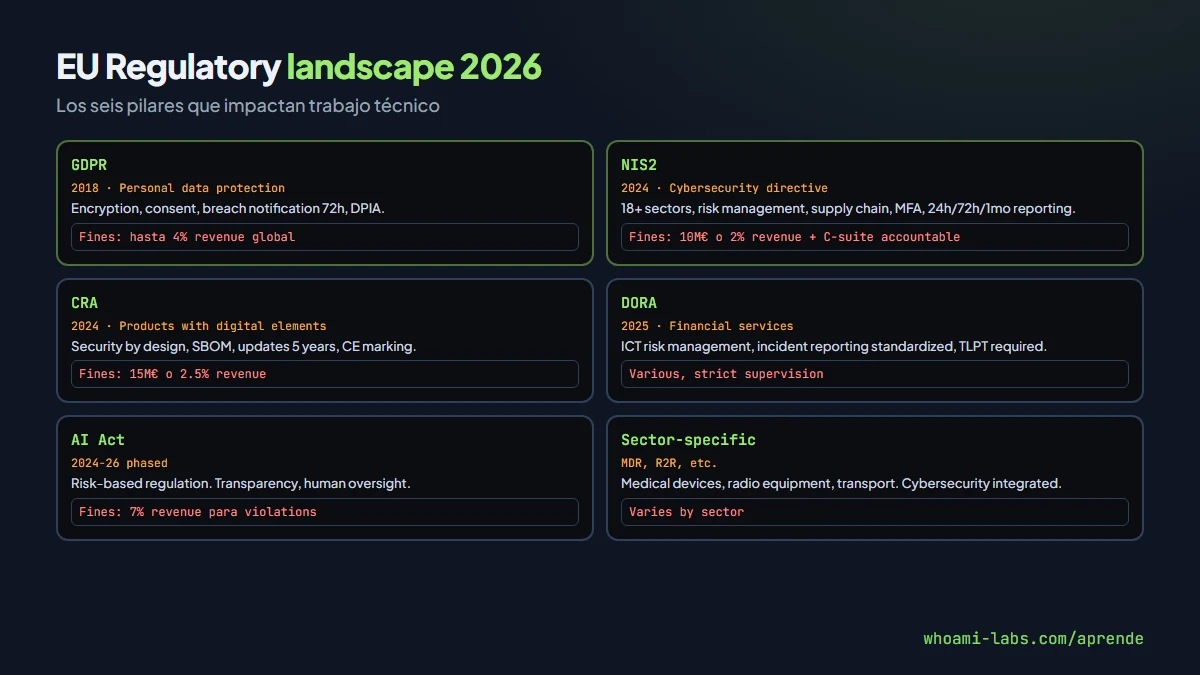
Pilares principales:
GDPR (2018)#
- Scope: data personales de residentes EU.
- Requirements: lawful basis, consent, data minimization, right to access/delete, DPIAs.
- Breach notification: 72 horas a supervisory authority.
- Multas: hasta 4% revenue global o 20M€.
- DPO: required para organizations with regular large-scale monitoring.
NIS2 (2024)#
- Scope: essential entities (energy, transport, banking, health, water) + important entities (digital providers, manufacturing, postal, waste).
- Requirements: risk management measures, incident reporting, supply chain security, cybersecurity training.
- Breach notification: 24h early warning + 72h incident notification + final report.
- Multas: hasta 10M€ o 2% revenue (essential), 7M€ o 1.4% (important).
- Management accountability: C-suite personal responsibility.
Cyber Resilience Act (CRA, 2024)#
- Scope: products with digital elements (hardware + software).
- Requirements: security by design, vulnerability handling, SBOM, security updates throughout lifecycle.
- Multas: hasta 15M€ o 2.5% revenue.
- Market access: non-compliant products banned from EU market.
DORA (2025)#
- Scope: financial services.
- Requirements: ICT risk management, incident reporting, resilience testing (including TLPT - threat-led penetration testing), third-party risk.
- Supervision: direct by ESAs for critical ICT providers.
AI Act (2024-2026 phased)#
Cubierto en lecciones AI. Risk-based regulation. Transparency, human oversight, conformity assessments.
Sector-specific#
- MDR (Medical Devices): includes cybersecurity for medical devices.
- R2R (Radio Equipment): IoT security.
- Various transportation regs.
GDPR: qué implementa el técnico#
Technical measures mandated#
- Encryption: data at rest + in transit.
- Pseudonymization: cuando posible.
- Access controls: RBAC, principle of least privilege.
- Audit logging: who accessed what when.
- Backup + recovery: tested regularly.
- Data minimization: collect only necessary.
- Retention policies: delete data when no longer needed.
- Vendor management: data processors require contracts (Standard Contractual Clauses).
DPIA (Data Protection Impact Assessment)#
Required para high-risk processing. Includes:
- Process description.
- Risks to data subjects.
- Mitigation measures.
- Compliance evaluation.
Technical input typical: threat model, security architecture, specific controls.
Right to erasure implementation#
User deletes account → actual data removal + in backups + from analytics. Technical complexity high, often overlooked.
Breach response#
- Detection: SIEM alerts within 24-48h ideally.
- Assessment: scope, data categories, affected subjects.
- Notification: 72h to supervisory authority (even if assessment incomplete).
- Documentation: everything logged for audit.
NIS2: expansiones del scope#
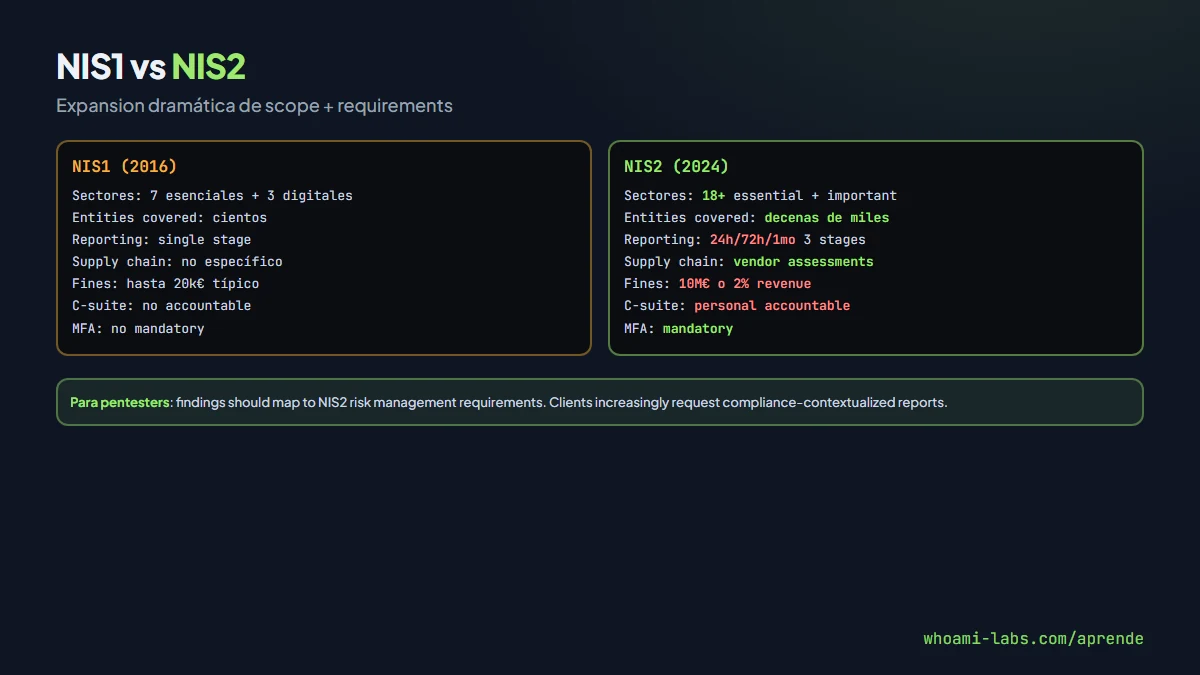
Sectors covered#
Essential: energy, transport, banking, financial market infrastructure, healthcare, drinking water, digital infrastructure, ICT service management, public administration, space.
Important: postal, waste, chemicals, food, manufacturing (certain), digital providers (search engines, social networks, online marketplaces), research.
Si cualquiera de estos: medium/large enterprise (50+ employees, 10M€+ revenue) → compliance required.
Technical requirements#
- Risk analysis + info system security policies.
- Incident handling.
- Business continuity + crisis management.
- Supply chain security (vendor assessments).
- Security in acquisition, development, maintenance.
- Policies para assess effectiveness.
- Basic cyber hygiene + training.
- Cryptography.
- Access control + asset management.
- Multi-factor authentication.
- Secure voice, video, text communications.
- Incident response.
Reporting timeline#
- 24h: initial notification (early warning).
- 72h: incident notification (more details).
- 1 month: final report.
Compared con GDPR 72h, más stages, more pressure.
Management accountability#
Novel: C-suite personal responsibility. Fines + potential suspension for failure. Drove massive investment en security programs across EU 2024-2026.
CRA: product security#
Hits manufacturers of hardware + software:
- Security by design: integrate security en development lifecycle.
- SBOM: software bill of materials mandatory.
- Vulnerability handling: process documented.
- Security updates: 5 years mínimo (longer según product).
- Reporting: exploited vulnerabilities to ENISA.
- CE marking: compliance proof.
Impact: software/IoT vendors must change development practices significantly. Cost significant for established products.
DORA: financial services#
Specific requirements:
- ICT risk management framework.
- Incident reporting standardized.
- Resilience testing: including TLPT.
- Third-party risk: critical ICT providers under direct supervision.
- Information sharing: encouraged + enabled.
TLPT = Threat-Led Penetration Testing. Scope defined, specific TLPT provider (certified), red team-level engagement every 3 years mínimo.
Práctica para pentesters y security pros#
Technical reports con compliance mapping#
Each finding map to regulatory requirement violated:
- SQL injection → GDPR Art. 32 (security of processing).
- Missing MFA on admin → NIS2 essential cybersecurity.
- Unpatched system → CRA security updates.
Clients appreciate direct connection to regulatory risk.
Architectural guidance#
Help design systems meeting multiple regulations:
- Encryption everywhere (GDPR + NIS2).
- MFA universal (NIS2).
- Logging + audit trails (both).
- Vendor assessment pipelines (NIS2 + CRA).
- Incident response playbooks (both).
Breach response support#
Assist 72h notification:
- Rapid forensics.
- Scope determination.
- Documentation para authorities.
- Coordination with DPO, legal.
Training y awareness#
Deliver security training meeting NIS2 requirements.
Compliance herramientas#
- Drata, Vanta: continuous compliance monitoring.
- OneTrust: privacy management platform.
- ServiceNow GRC.
- Secureframe.
Para small orgs: spreadsheets + policies + occasional external audit sufficient.
Walkthrough: breach response NIS2#
Para fijar el patrón, un escenario breach con NIS2 timeline:
T+0h - Detection: SIEM alert anómala. Investigación confirms ransomware deployment.
T+2h - Incident declared: IR team activated. CISO notified. Clock officially starts.
T+6h - Scope assessment: Affected systems identified. 2000+ workstations, server data accessed.
T+12h - Business impact: Operations halted. Public-facing services down.
T+24h - NIS2 early warning due:
To national competent authority:
- Incident declared: [datetime]
- Significant impact: Yes
- Nature: Ransomware with exfiltration
- Scope estimate: [users, services affected]
- Cross-border: Potentially (customers in multiple EU countries)
Submission mandatory even with limited info.
T+48h - Technical remediation progresses:
Isolation complete. Forensics ongoing. Backups restoration planning.
T+72h - NIS2 incident notification due:
More details:
- Root cause suspected (phishing).
- Specific systems compromised.
- Mitigation actions taken.
- Estimated recovery time.
- Services affected to users.
T+1 month - Final report:
- Comprehensive post-mortem.
- Lessons learned.
- Preventive measures implemented.
- Regulatory discussions re: any penalty.
Parallel: GDPR 72h notification if personal data affected (usually in ransomware). Different authority if different scope.
Compliance en la práctica cotidiana#
Para orgs EU, compliance es ongoing:
- Quarterly risk assessments (NIS2 requirement).
- Annual DPIAs updated (GDPR).
- Annual security training (both).
- Vendor assessments (NIS2 supply chain).
- Incident response drills (both).
- Logs review periodic.
- Policy updates based on regulatory changes.
- Budget planning para compliance activities.
Compliance budget typically 15-25% de overall security spend 2024-2026.
Errores comunes#
- Treating compliance como check-box vs ongoing program.
- Pentest findings sin regulatory context.
- 72h clock starting late (should be as soon as aware).
- Forgetting backups en right-to-erasure requests.
- Ignoring supply chain requirements.
- No management accountability processes.
Preguntas frecuentes#
¿GDPR aplica si solo tengo clients EU?#
Yes. Territorial scope includes processing data of EU residents regardless where processor located.
¿NIS2 applies to my small company?#
Depends on sector + size. Medium (50+ employees o 10M€ revenue) en covered sector = yes. Smaller may be covered como «suppliers» de essential entities.
¿CRA affects open source?#
Debated. Final text has exemptions para non-commercial open source. Commercial distributions covered. Impact on OSS ecosystem concerning many.
¿TLPT vs normal pentest?#
TLPT: more realistic (specific threat actors simulated), longer duration (weeks-months), certified providers only, higher cost. Normal pentest sufficient para most compliance; TLPT para high-risk financial.
¿Carrera path en compliance?#
Growing field. Combine security technical + legal understanding. GRC roles, DPO positions, compliance consultant. Certifications: CIPP/E, CISSP + specific regulatory focus.
¿AI governance en regulation?#
AI Act main vehicle. GDPR applies (automated decision-making provisions). NIS2 covers AI systems en essential sectors. Emerging area con regulatory maturation ongoing.
¿Dónde practico?#
El laboratorio snort de whoami-labs incluye simulated compliance scenarios: breach response con 72h timer, DPIA templates, NIS2 risk assessment exercises. Practice coordinating technical + regulatory responses realistically.
¿Impacto NIS2 en outsourcing?#
Significativo. If outsource ICT to critical provider, provider now under direct NIS2 supervision. Vendor contracts need update. Supply chain risk assessments mandatory.
¿GDPR extraterritorial reach?#
Yes. US companies processing EU resident data subject to GDPR. Caused massive privacy investment en US tech giants 2018-2026.
¿Cómo prepare org para NIS2 audit?#
- Gap analysis contra requirements.
- Document policies + procedures.
- Evidence collection (logs, trainings, assessments).
- Mock audit internal o external.
- Remediate gaps priority order.
Compliance consultants help significantly. Cost 50k-500k€ depending org size.
¿Fines actual impuestos?#
Multiple GDPR fines sobre 100M€ documented (Amazon 746M€, Meta 390M€, WhatsApp 225M€). NIS2 fines emerging. Enforcement real, no just theoretical.
¿Technical pentester necesita legal knowledge?#
Yes increasingly. Not practicing law, but understanding regulatory context essential. Enables writing reports compliance teams can actually use. Differentiates practitioners en marketplace.
¿Brexit impact UK pentesters?#
UK GDPR largely mirrors EU GDPR. UK not under NIS2, pero similar UK-NIS regime. Dual standards for UK pentesters serving EU clients. Added complexity navigable con study.
¿Future direction regulatory?#
More harmonization expected. More stringent cybersecurity requirements globally. AI governance major vector. Privacy continues strengthening. Costs rising, pero so does market de compliance services.
Resumen#
- EU regulatory landscape 2026: GDPR, NIS2, CRA, DORA, AI Act + sector-specific.
- GDPR: personal data, 72h breach notification, DPIAs, 4% revenue fines.
- NIS2: cybersecurity across 18+ sectors, 24h/72h/1mo reporting, management accountable.
- CRA: product security con SBOM, security updates 5 years, CE marking.
- DORA: financial services, TLPT required, third-party risk.
- Technical measures: encryption, MFA, access controls, logging, backups, incident response.
- Pentesters: map findings to regulatory requirements, assist breach response, architectural guidance.
Cierre de la Tanda 6#
Esta lección cierra la Tanda 6 de /aprende, completando 90 lecciones totales distribuidas en 6 tandas temáticas. El journey desde fundamentos (permisos Linux, Nmap) a frontier topics (LLM security, post-quantum crypto, hardware hacking, compliance regulatory) cubre el panorama técnico completo de ciberseguridad moderna como lo entienden profesionales en 2026.
Para la organización whoami-labs, estas 90 lecciones forman una biblioteca de referencia que combina technical depth con context industrial actualizado. Para los estudiantes, un currículum estructurado que no requiere pagar coursera o Udemy. Para profesionales buscando llenar gaps específicos, resource gratuito con laboratory environment where practice real techniques en un setting legalmente autorizado y seguro.
El próximo paso natural es ampliar los laboratorios prácticos, actualizar contenido conforme el campo evoluciona (ciclo típico 6-12 meses para review completo), y potencialmente crear community contributions. La biblioteca es foundation; su valor crece con uso continuo y refinement iterativo durante los años siguientes a su publicación inicial.